Student Spotlights
Nat Ratchford ‘28
“When you're playing in a band, any type of band, you learn how to be selfless in the sense where you have to not put the spotlight on yourself all the time. So, you have to like contributing to a bigger goal and to accomplish something bigger than yourself.”
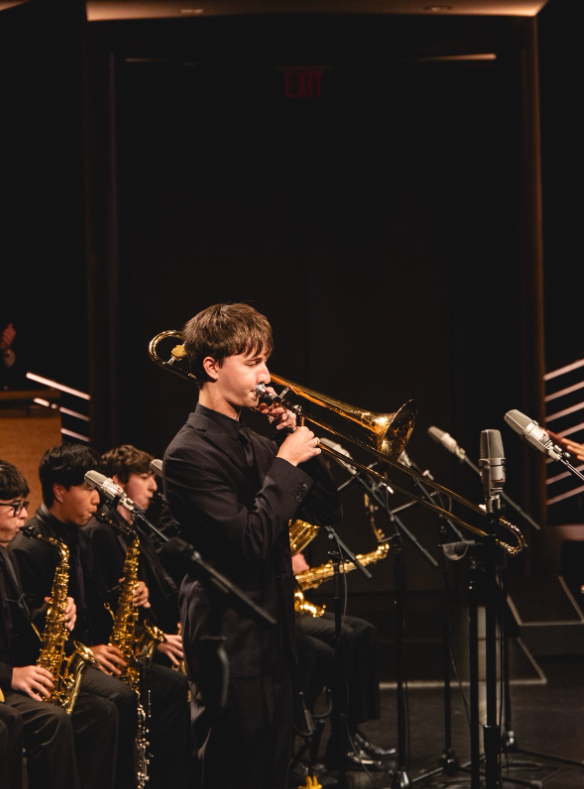
Nat Ratchford with “Outstanding Trombone,”
A junior band major and trombonist, Ratchford has been playing the trombone since sixth grade, after experimenting with different instruments in elementary school. His musical background, however, began even earlier. He started playing piano at five, growing up in a family where music was a major part of life. That family influence helped introduce Ratchford to jazz, but what ultimately drew him in was the emotional range of the genre.
“Jazz has so much variety, to the point where you can experience soothing emotions, heartbreak, anger, happiness,” Ratchford explained. “You can really experience all sorts of emotions when you listen to different types of jazz.”
For Ratchford, that emotional connection is what makes jazz special. But pursuing it seriously requires more than simply enjoying the music. It requires time, lots of it. His dedication becomes even more apparent when he describes his practice routine. During second period, Ratchford can spend about an hour practicing through jazz combo and individual practice-room time. Once he gets home, he usually plays for another two to three hours, sometimes four, depending on his schedule. On weekends, his practice can reach up tp approximately four hours.
That commitment has already produced some major accomplishments.
During a band trip to New York City last school year, Ratchford’s band placed third in the world at an international competition, and he was individually recognized as an outstanding trombonist. After spending the entire school year working toward the competition, seeing that effort pay off became one of his most meaningful accomplishments.
“ I just felt that it really meant a lot to me because we had worked the entire school year towards that specific event in that competition, just to see the hard work pay off. I just felt like it was a big sense of, like, relief and also just genuine accomplishment and joy,” Ratchford said
When playing in an ensemble, Ratchford says musicians have to learn how to contribute to something larger than themselves. Even during an improvised solo, a musician cannot simply play whatever they want. They have to listen and respond to the other musicians around them.
He compares the process to a jigsaw puzzle: each musician has to find their place without becoming an outlier.
“When you're playing in a band, any type of band, you learn how to be selfless in the sense where you have to not put the spotlight on yourself all the time. So, you have to like contributing to a bigger goal and to accomplish something bigger than yourself,” Ratchford said.
Every year, the J1 jazz band has to rebuild its chemistry as new members join and seniors graduate. According to Ratchford, becoming a strong ensemble requires the musicians to know one another beyond the band room. They have to become comfortable with each other, spend time together and learn how to be vulnerable.
“Whatever type of band you're in, it's always going to be better, playing as a group when you know each other,outside of the band room are able to just be vulnerable with each other, the closer band is, the band is with each other,the better they sound, usually. It's actually a really cool phenomenon,” he said.
That sense of community became especially important after many of the seniors Ratchford had grown close to graduated. Although their departure was difficult, he was impressed by how the jazz department adapted, with new musicians stepping into their roles and the ensemble developing a new identity.
Now, as one of the more experienced members of the band, Ratchford sees himself not only as a musician but also as a leader.
“Last year I was going through something, I want to make sure I'm there for them, because,last year, my sophomore year, when I was going through, really difficult times, for a few weeks,I had that support, from Mr. DeLeon and other students. So, I want to, like, be there for students, just in the same way that people were there for me,” he said.
That philosophy seems to capture what Ratchford’s approach to jazz has become, knowing when to listen, when to support someone else and when to step into the spotlight.
For students interested in experiencing that chemistry firsthand, Ratchford has one simple recommendation: come hear the jazz department perform. The group is preparing for a series of performances throughout the school year, including October Jazz Night, November Jazz Night and Prism.
After all, for Ratchford, jazz is not just about playing the right notes, it is about understanding the people playing beside you, and finding a way to make all of those individual voices sound like one.