
The Otori Feather
The nestings and housings in Kanake seemed smaller now, at least compared to when Morah was a fledgling.
Kanake had grown to develop larger buildings over the last hundred years or so. Now, they were taller, wider, and more compact. They were built into the mountains and hills that Kanake sat between, with those in the Kana Valley in grids.
The aqueducts that ran along the mountainsides were strengthened, too, reconstructed with the volcanic dust dug out of the largest mountain (or inactive volcano) to the north. Compared to Minou Springs, or the Meganthar Fields, Kanake was the largest city many people this side of the Iwana River would ever see.
This now-developed Kanake, strengthened and regionally dominant, was all that Morah knew: the ever-improving Kana Valley, Kanake City, with her destined to, one day, oversee it.
When Morah grew up here, it was all so much bigger, so much more daunting. These buildings swallowed her whole, given that she couldn’t fly over the city as well as she can now, on account of her undeveloped fledgling wings.
Growing up, Morah held disdain towards these buildings (opposed to the appreciation for them she has today). Her mother, the Matriarch of Kanake, Reika Otori, would lecture her on the active loss of Kanake’s culture, of their old imperial buildings, and how those “good for nothing architects don’t care about preserving our culture! I swear, they’d rather make something modern and Iwanese rather than stay true to their Kana identities. We’re losing all that makes our state powerful, understand, Morah?”
Morah grew up in an echo chamber, composed of just her mom and their manor’s reverbing walls. Everything that Reika said was the utmost truth to Morah, words she’d follow like they were told by a burning bush.
Morah was not permitted to leave their manor as a chick. She likely never even saw another bird her age until she was old enough to fly short distances.
The reason? Well, Reika said she was above them. A future matriarch was not to be socialized with the commonbirds her age. In Reika’s youth, noblebirds still existed. But in the age of development and increased parliamentary involvement, those class ranks fell, and Morah was left with no one but her mother and their servants.
A future matriarch should not socialize with those below her– and Morah was above everyone.
In Morah’s later fledgling years, she became a smaller version of her mother, aside from the purple hued brown feathers of her nape. Reika was purely white with a deep navy crown of feathers and navy wings. She was the definition of beauty, the imperial standard for any heron to be.
She hoped Morah’s nape feathers would lighten with age.
Aside from physical appearance, Morah acted with the same entitlement of her mother. That royalty ran through her veins.
The commonbirds she interacted with daily, the servants and what not, could put up with her mother. She had been ruling for decades, and for the Kana, disrespecting an elder, especially a matriarch, was beyond taboo.
Morah, despite being raised to expect it, had not earned that same respect.
Some fall morning in Morah’s later fledgling years, at that time of year where the tree leaves turned a yellow-ish orange and the streams running off the mountains cooled, Morah had been searching through the manor halls for her mother and was coming up empty. The manor was bigger than she or her mother needed, but this home was generational. Even still, these halls Morah had learned to call home felt empty.
The walls and crown moulding, painted and formed by the herons before them, were far from minimalist, still holding that imperial Kana style from when the Kanake state (practically a city-state now) was the Kana Empire. The decor that coated the hallways were more artifacts than mere decorations, each one holding a story that Reika had told to Morah, in hopes of preserving their history, rooted in conquest, and modernly actualized into a rump state.
After what felt like hours of scouring in her manor’s labyrinth of halls and vacant rooms (of which she could navigate with her eyes closed, seeing as she rarely left this place), Morah found a preoccupied servant.
This one was a killdeer, a shorebird with a brown back and wings, and a white belly with three large black stripes. She must have migrated there after the Iwana took the beaches for themselves. Morah had always assumed the killdeer that worked for her and her mother were kin, seeing as they were always grouped together. But this time, this bird was on her own.
Morah couldn’t quite tell which one she was, given that they all wore the same simple, beige robes. But this lack of identification didn’t matter to Morah at that moment. No, what mattered was the fact that this migratory killdeer had lifted the glass casing off of an Otori feather, generations old, an artifact in which she had no right to touch.
Even then, Morah must have known that this girl would have no way of knowing that this was off limits, but Morah didn’t care. She was going to know.
“What do you think you’re doing?” Morah raised her neck, attempting as best she could to tower over this poor maid. Clearly, it was effective. Morah’s echoing voice and large stature made the girl let out a sharp seet call as she jumped back, dropping her duster. Morah continued to approach forwards.
“I- well, I was dusting the…” the girl stuttered as she tried to pick up her duster and compose herself, with no help from Morah looming above the girl, “I was dusting the casing and noticed that some dust had gathered beneath it.”
Morah had dealt with this before. This sort of incompetence, she had learned, was best handled with silence. The pitiful killdeer was shaking at this point. She had to have been older than Morah, but she had no power here.
“I promise, I- I’d never steal or mean to harm-” the killdeer lowered her head, almost bracing for the impact she knew would come.
“You realize this is an Otori feather, don’t you?” Morah’s tone was deceptively soft, a ploy to catch the girl off guard. The killdeer glanced up at Morah.
“I, of course I do, that’s why I-”
“I recognize that you don’t have much knowledge of Kana history, let alone any scholarly knowledge, but if you intend on keeping your job here, I recommend you learn the importance of our late leader’s remains to not just the Otori household, but the Kana people.”
Now, Morah knew that this Otori feather, from an inconsequential leader just three generations ago, was not worth much to her, or anyone, aside from her mother. But this girl had to learn her place one way or another.
“I figure she’s learn’d ‘er lesson by now, Ms. Otori,” an older kestrel echoed from the other side of the hall. He had an abrasive Minou accent, straight from the swamplands. He made his way towards the two of them. The killdeer practically sprinted to his side. “If you wanted ‘er to be afraid of ya, ya’ve done it,” he said, looking up at Morah, unfazed by her size or her power hungry antics, before turning towards the girl, “c’mon Naia, I’ll find a use for ya else where.”
His tone was cautious. He picked his words carefully, to not set Morah off more. And she knew that. Most commonbirds, Morah would soon learn, banded together against her. Tales of her condescending nature got around, and in a time where most Kana viewed the Matriarchs as a relic of the past, as a poster child remaining on the wall for the sake of tradition, no commonbird willingly wanted to put up with Morah.
Morah was left alone in the hall.
She went back to her chambers. There wasn’t really any intention behind returning. She just never had anywhere to go aside from her room. She’d have laid down, and stayed there for longer than she should, but she’d had her crest feathers raised today, and wasn’t in the mood to fix them.
She went to her bathroom, simply to stare at herself in the water basin below her. She recognized who she saw below her. Not Morah, but Reika. She was practically identical to her mother. Morah figured this was what becoming a matriarch was and that she was doing a good job at it. But the heron in her reflection was not one she identified with.
Morah, for a long time now, had no identity of her own.
She reached into the water, and wiped the thought off, rippling her reflection away with it.
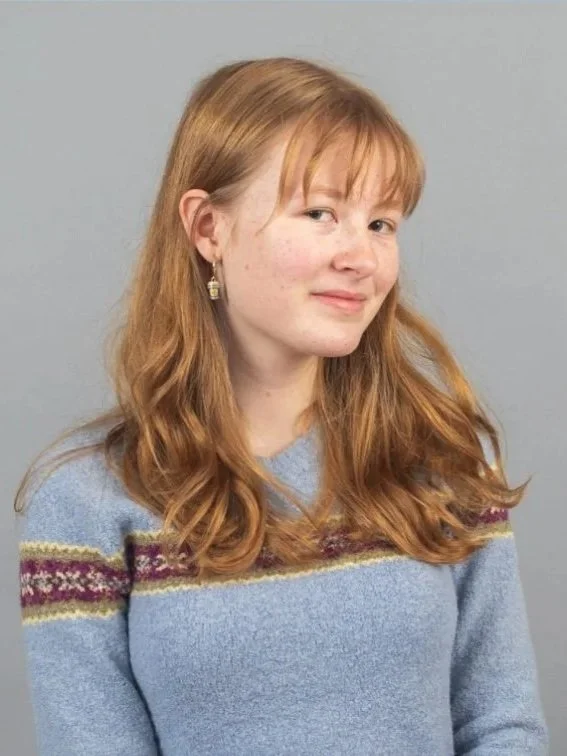
Becca Cross ‘26
This piece dives into identity and the loss of self in order to fit into the roles that Morah believes are set out for her. I worked on this piece in order to build on my worldbuilding skills, and to integrate a world I have mapped out factually and visually into a genuine plot. The Otori Feather functions as a key plot point, and it is chapter within a larger piece, but the chapter itself stands strong, and I intended to leave the reader questioning, just like Morah.