
Jessica
It’s odd getting hit on for the first time in public.
At least, that’s what you think happened. It was
All a blur, wasn’t it?
You’re at Publix, you’ve gotten a Pubsub, and you’re
trying to find a cool drink, buy your first Arizona.
A kind man stands beside you and recommends
an Arizona lemon iced tea. He says it's his
favorite as he gets shoulder-to-shoulder.
You foolishly put down the kiwi lime you
chose to get, the one he recommended, and he smiles.
He’s a stranger, but not really, right? After all,
he was beside you when you ordered your Pubsub.
It seemed friendly enough when he kindly excused
himself, while moving behind you to order. Sure, he
took some looks, but that’s what kind, curious men do,
right?
The Arizona in your left hand, he asks for your name.
“...Naima”
“Naima?”
That’s dumb, that's stupid, that’s so foolish of you.
That’s too close to your real name, Naama.
Why not go for Jessica instead?
You were too startled to, I guess.
Too off guard to think of anything else
but a mispronunciation of your own name.
Didn’t he ask you how old you were?
Did you tell the truth?
You don’t remember, your mind’s forgotten.
Didn’t he ask you what you were doing afterwards?
Didn’t he ask you if you wanted to leave with him?
You don't remember, your mind’s forgotten.
Didn’t he say his name? Why didn't you ask?
You don’t remember, you’re stupid,
your forgetful mind’s forgotten.
Didn’t you shake the hand he held out?
Yes, your mind remembers vividly,
your smooth right hand engulfed in his
aged one, and you realized just how much
he towered over you. His palm dry and
firm, you realized just how young you are.
You should wash that hand before you eat.
You’re now outside, talking to your dad over the phone.
You’re happy and forget about the strange interaction.
Until he honks—
Again—
Again—
Again—
You turn, and he’s there, staring and smiling.
He offers to drive you to work. You said you had to
work when he asked what you were doing after, remember?
Did you say yes?
No, you pleasantly said no thank you.
Your dad on the phone, miles away, is
none the wiser, you’re none the wiser.
The white van drives away.
You could’ve sworn you covered yourself,
only the skin of your arms showing.
Guess your pants hugged your curves too close,
your lips too plump, your voice too mature.
Too much of a target to ignore, you suppose.
You should’ve worn your sweater.
If you were Jessica, would he have held your hand
tighter? Would the security guard have noticed you
and looked at you? Would the man have insisted he
drive you? Would he have put up more of a fight?
You huddle into yourself. You walk faster to
the Kravis, the familiar structure comforting.
You wash your hands three times
before you finally eat,
the Arizona tasteless.
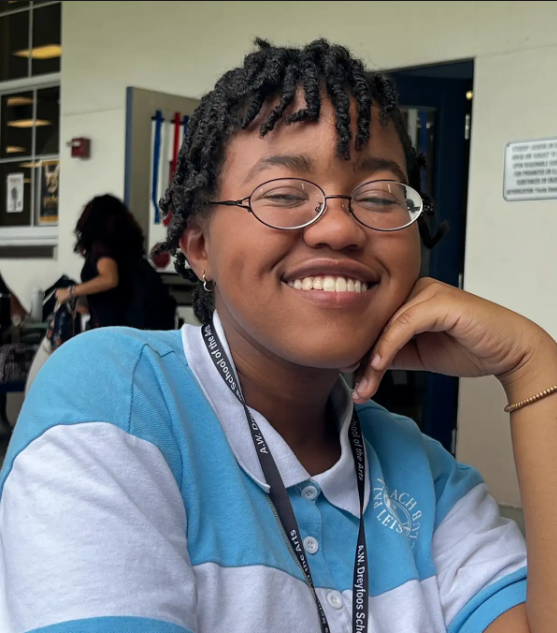
Naama Gomes-Sammah’ 26
Funnily enough, when I got home that night and told my Mom the name I gave him, she said I should've gone by Jessica, too, hence the name of the poem. I wrote this the same night the events occurred to ensure I would never forget and could look back on it as a learning experience. The poem is written in a second-person internal monologue so that not only I could remember how I felt at the time, but also for others who may or may not have gone through something similar. As for some fun facts: the structure of the stanzas containing three lines represents the number of times I saw the stranger, and I wrote the poem in "Average" font as a callback to the average Tuesday all of this occured.
Marigolds
Marigolds and humans have only one thing in common: neither has any natural predators.
Although there is no animal to mangle our bodies, sink teeth into our flesh, and maul chunks of
meat off our bones,
we both fall prey to human beings, are strategically stalked by them.
Feel wrinkled fingers gripping our limbs,
pass by us in the garden as they eye us up and down.
Lusting to pluck pretty petals off our bodies.
Rip us from our roots, pick us off our feet,
Cut half our stems, peel the ugly parts from our frames.
They don’t start as aggressively.
Don’t shower us with sugar-drugged water,
Take our hands and press tight-lipped kisses onto them.
Flower us with empty compliments,
about how beautiful we are,
how our scent is pleasant,
how they would love to twist our stems,
twirl our arms, dance through jazz,
lights shining down our backs.
They mimic the ones closest to us,
the one who will sit with me when I cry.
The one who walks me to the door to keep me safe,
but they are simply a viceroy to the monarch we strive to find.
So our vision begins to blur,
heads start to spin.
We begin to feel nauseous.
As rough hands grip our waists.
They begin to rip our petals,
To deflower us.
The red marigolds, with love-struck eyes. Petals plucked from ones believed to love them.
Forced by the thought that it’s just what needs to be done. That in holy matrimony there is no consent.
That one is able to simply tear another's roots from the soil because they lie in their garden.
Because they are bound to them, promised to them.
That petals picked by lovers are never stolen, but rightful property.
That it was excusable for Gisèle Pelicot to be drugged and raped 92 times by 72 different men,
all facilitated by her husband. That masculinity was king because she wore his ring.
Or that in a country where marital rape laws were nonexistent until 1993, when it finally became a crime
in all 50 states.
Where the laws are still seen as unnecessary, where the rape of a spouse is less important than that of a stranger.
Where the means of reporting are harder: that your time limit is shorter, that “you may have to show that your spouse used more force than if you had not been married to them.” That they “caused you bodily injury or used a weapon.”
The white marigolds, with childish hands, petals that haven’t yet bloomed.
As a little girl begins to crawl, babble through words, a flower with no defense.
The white of her soul now tainted, innocence stolen without remorse.
Groped under fluffy blankets on a bed that was supposed to be for comfort—
by family members, church pastors, tutors, teachers, parents, siblings.
The ones that are supposed to protect.
As caloused hands suffocate out the truth.
Prune children to be afraid, to stay quiet.
Prune children to think it is their faults
They tore a princess onesie off her frame, treated her like anything but royalty.
The white shirt layered under green overalls, an outfit gifted during a baby shower. Ripped off hangers from the Children's Place, as if measly petals.
This child would go on to never wear white and green again.
The orange marigolds, the ones for those who have been demoted to mere redactions on a PDF.
Simple statistics we hear on the news of the women and children who die due to sexual assault and abuse every year.
Names ignored, taken over by the abuser, the offender.
No one remembers the name of the victim, but everyone remembers Jeffery Epstein.
The orange marigolds, placed on ofrendas, because “prayer is the only way to guide their souls” to the paradise that this lifetime didn't bless them with.
When laws are ignored, when a sex trafficking ring goes so far into the politics of our country, the ones supposed to protect us, turns to protect abusers.
People turn a shoulder to women and children who are murdered in broad daylight, allowing the peachy hues of the sunrises to blind them.
People are forced to solve their own suffering,
when the last petal is torn off, when the stem is sliced down the middle.
When the flower finally dies.
When it is so abused, so infected, as a last resort, it will begin to kill parts of its own body.
This is the only way it knows to protect itself.
Despite the fact that we are just bodies, just bouquets of beauty to them, just figments of beings.
Although they steal pieces from us, collect fragments of us, pockets full of our small petals,
there is nothing we can do but attempt to wash the feeling off,
to wait for the rain to stream over us like a holy shower,
to scrub the lingering fingerprints left on our stems,
to plot ourselves in the same patch of dirt and grow side by side.
To reassure each other, this wasn’t our fault.
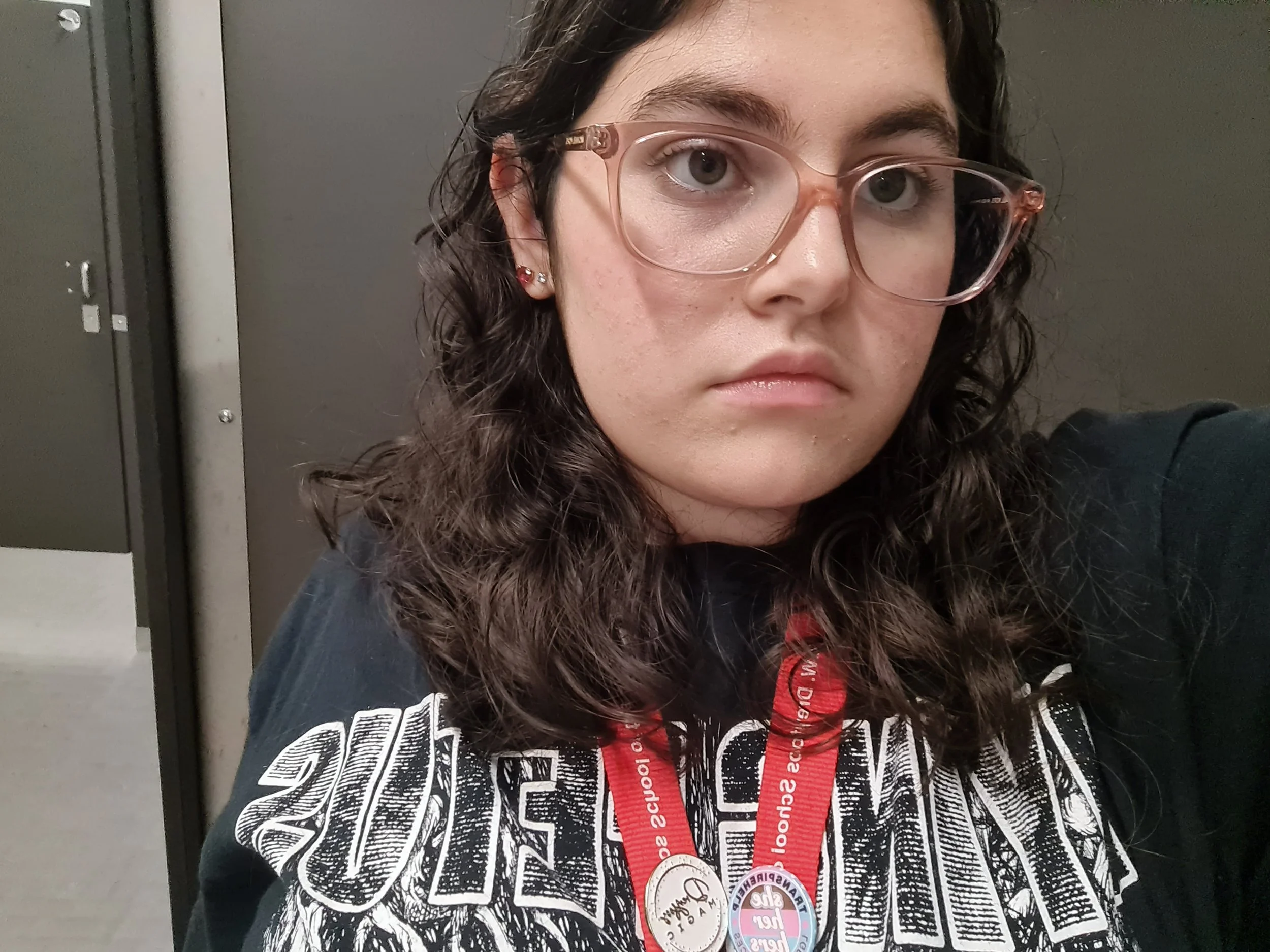
Bianca Angelino’ 26
I wrote this piece after attending Interlochen Arts Camp for creative writing over the summer. There, I took an environmental class and learned that marigolds don't have any natural predators because of their smell. Originally, the idea inspired a different poem, but then it made me think of this comparison. I thought it was really interesting to connect the way humans are predator to flowers and to other people, in the form of assault.