
Deaf Mute
There is only one school that I am banned from applying to. My grandfather, Abe
Szmukler, outright refuses to say the name. That school is Yale.
The reason might seem a little silly. Abe, born 10 miles west of Havana in 1943, had a
broad, heavy accent. He had the cadence of a revving up lawn mower, occasionally punctuated
by a Spanish curse word muttered under his breath. He feared that if he were talking to his
friends about his grandkid, “Yale” would sound too much like “jail.” It usually was the soft
consonant sounds at the beginning of words that would trip him up. Every word had to have a
diving board in front of it, something solid to leap off of.
He escaped Cuba in 1963, a few years after the Castro revolution. He did so on his own,
hitchhiking a boat to Spain. He studied for four years at the University of Madrid, pulling
all-nighters at cafes to get his MD. Afterwards, he moved to New York to complete his study of
anesthesiology. He met my grandmother, a nurse, at Mount Sinai Hospital.
In the U.S., Abe had trouble ordering at restaurants. If he did enjoy an establishment,
he’d get to know everyone there. The owner, their spouse, and the lady who plays piano every
Monday, Wednesday, and Friday. He’d add them to the call rotation list, dialing numbers one by
one on a Sunday afternoon from his recliner. At new establishments, there were a couple of
things he couldn’t order, though. For one, he couldn’t order “soup.” In Spanish, soup is “sopa,”
so he’d usually end up trying to order “soap.” For similar reasons, he couldn’t order “sheets” or
“ships.” The words with a long “i-h” sound seemed to almost hurt him, the
vowels getting stuck in his throat, and he’d try to dislodge them like a salt shaker.
My biggest regret is not learning Spanish earlier; I really started learning in the fifth
grade, which seems early enough. However, I never practiced with discipline, and the
conjugations faded from my brain. During COVID, Abe and I would call on Zoom, practicing
from the "Spanish For Dummies” book that each of us had at home. I didn’t like thinking I could
possibly be a “dummy,” but I felt validated when Abe would read a sentence, tell me to “wait a
minute,” reread the sentence, and go, “who wrote this? no one would ever say that,” hand on his
shiny head, rubbing his palm into his scalp like he was buffing a bust.
While I am trying to remediate my lack in one language, I should mention I was never a
master at English either. Throughout almost all of elementary and middle school, I was in
speech-language pathology. As a child, I was literally born with more than I could chew. My
tongue was so big, it wouldn’t stay in my mouth, and it would dangle around, slapping the
corners of my mouth, the clapper of the clock tower in my head.
“Ok, I want you to try that sentence again, really focusing on your tongue placement,”
my pathologist said, pointing at a picture of Superman.
“Tz-uper man tz-oars f-rough the air,” I said, scanning around the closet-sized room,
itching to get out.
“Ok. Not quite right. Let’s try that again.”
It was tough love. It worked in the sense that I started to hear my lisps, breath escaping
through my teeth, leaky valves. However, I ended up wanting to talk less, afraid everyone I
talked to was watching my teeth, waiting for my rabid tongue to slip through the cage of my lips.
One week, I caught a cold, and I used the opportunity to fake a throat rash, using a handheld
whiteboard to communicate.
“Ben, please stop, I know you can talk,” my English teacher said when she asked me a
question.
“Mmm, mmmm mmm.” I don’t know why I thought humming would help my case. I’m
pretty sure it would hurt more than just talking, but I only realized that in retrospect.
I later discovered I was not the only one to give up on talking altogether. My mom and
Abe used to live right next to a Dunkin’ Donuts, and he tried his best to order breakfast there.
“Sorry, one more time?” The cashier leaned over the counter to the point her toes nearly lifted
into the air.
“B-oh-st-ohn cream, the d-oh-nut.” He practically lost his breath trying to push the syllables out.
So, when he returned to Dunkin’ for the next couple of years, he carried a grocery list of
orders and handed it to the cashier, never having to speak a word. Once he paid, he’d find a table
to himself and watch the cars drift through the driveway, summer greens turning to autumn
reds. One day, when we walked up to the counter, a new employee asked for his order, and her
coworker tapped her on the shoulder.
“Oh, don’t worry, he’ll give you a list. He’s a deaf mute.”
My grandma still laughs about that story. I mean, most of Abe’s stories are hilarious, like
the time he accidentally concussed my mom with a frozen bagel or tried to spell his last name,
Szmukler, in Japan by using a phonetic alphabet of Asian car companies. While I’d laugh around
the Rosh Hashanah table, there is something about the story that always makes me uneasy. The
heaviness of the words and the casual way they fell out. Abe was never bothered by
the story. But, then again, I never shared how speech therapy made me feel, either.
In eighth grade, I was going to be enrolled in my sixth year of speech pathology. Sitting
down at the round table, sweaty lunch tray on the table, the room only decorated by the soft
ticking of a clock, we were each handed a paper survey about what we were looking to improve
over the year.
“This year, I hope to get out of this classroom. I hate being called out of class every week
just to say a few words. Being in here makes me feel like an idiot. I hope to never come back
ever again.”
I was never called back. I was used to the walk of shame every week. A knock at the
door, my name exchanged over a few whispers, and my teacher asking me to get up in the
middle of class to follow my speech therapist out of the room. I would see her in the halls
occasionally, and I would nod my head in the hopes of saying, ‘I didn’t mean any of what I said
about you, I was mainly angry at myself,’ but I know that nothing I can say will unsend my
survey.
Abe passed away later that same year. The last time I saw him, he couldn’t speak. Every
second in the dark guest room was crushing. The only light there seeped through the crack in the
door, from the hallway, leaving a streak of yellow across his red eyes.
Almost all of my regrets centered around my grandfather, the weeks after his passing. Besides learning
Spanish, I wished I were more grateful for his stories, for his presence. In elementary school, I
thought everyone had a story, so no one’s story is particularly special.
But maybe, if instead of letting my mind wander, melting away into those bread-loaf couches, I had been
listening with the respect he deserved, I would have known when to “break away.”
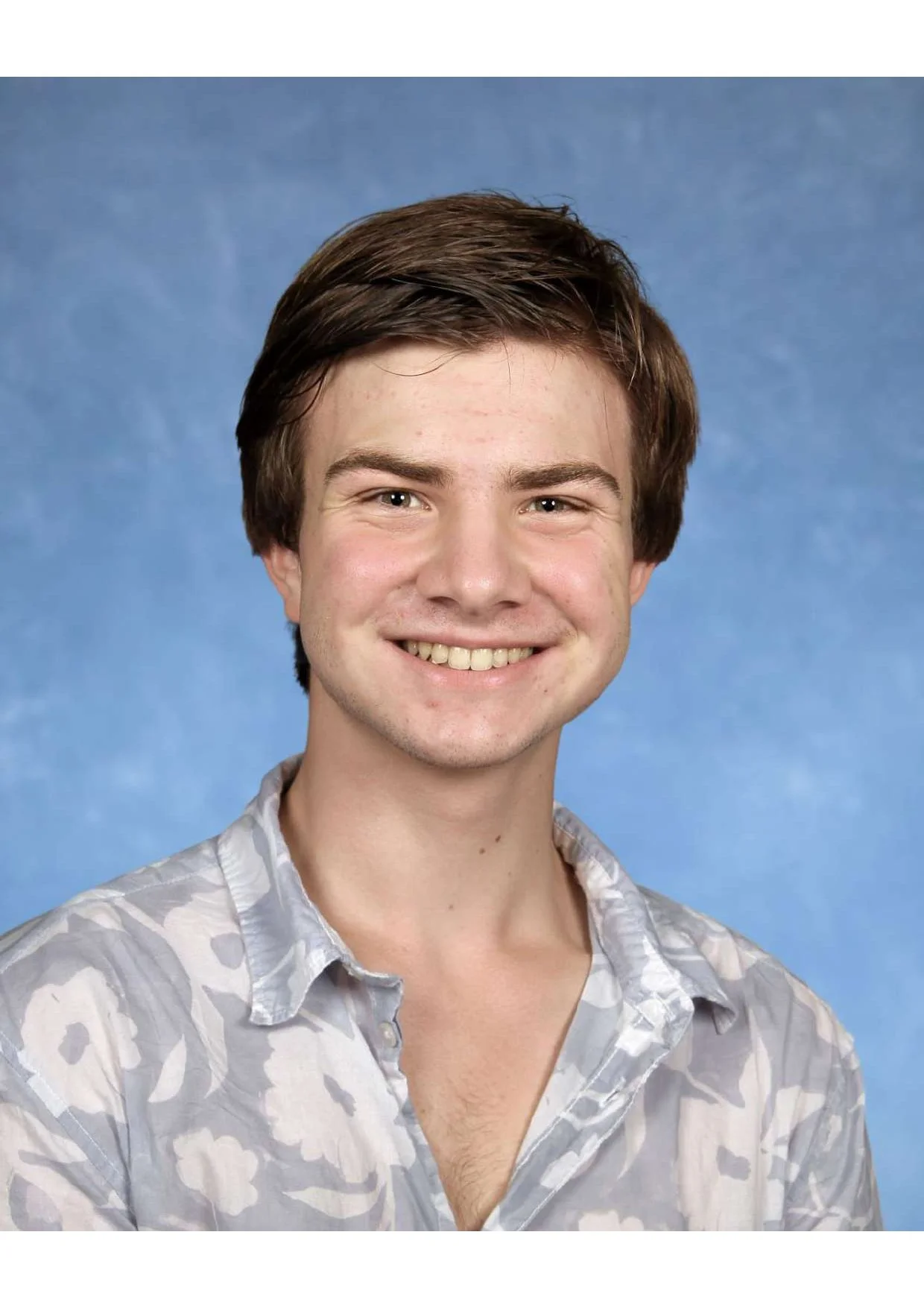
Ben Seelig ‘26
My grandfather was such an influential figure on my upbringing, both in what he bestowed on me in a literal sense, but also in the comfort I found with him on a deeper level. I wanted to sit down and find the details that binded us closer than just kin. Bonding over our language barriers, I was able to find comfortability in working within the constraints of my own mouth.